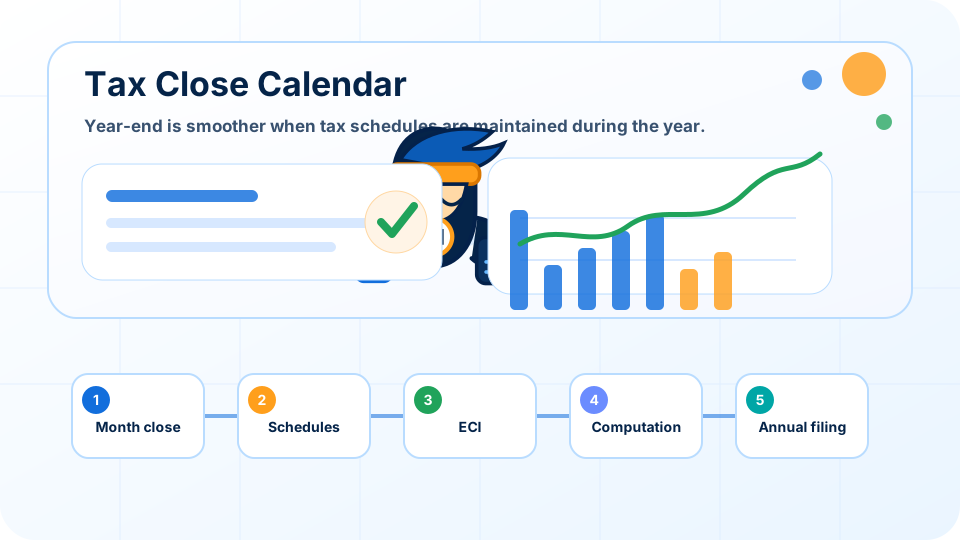


Singapore corporate tax readiness begins with a reliable monthly close, because ECI and annual tax work depend on reconciled accounts, documented adjustments and current IRAS guidance.
Key takeaways
- Close material accounts and resolve major evidence gaps before estimating taxable profit.
- Maintain fixed-asset, loan, accrual, prepayment and related-party schedules during the year.
- Separate accounting profit from tax adjustments and explain the bridge to directors.
- Check current ECI, return and ACRA filing rules for the company profile instead of relying on a generic calendar.
How ECI, tax computation and year-end close connect
The year-end close establishes the accounting result and the evidence behind balance-sheet and profit-and-loss figures. Estimated Chargeable Income uses that close as a starting point, while the later tax computation documents adjustments, exemptions and claims under the rules that apply to the company.
These are connected but distinct outputs. A management profit figure is not automatically taxable income, and an annual return to ACRA is not the same as a corporate income-tax filing to IRAS. The close calendar should identify each output, owner, source schedule and approval point.
Year-end starts with a reliable monthly close
Corporate tax work becomes difficult when monthly records are incomplete. If bank reconciliations are late, receivables are unclear, supplier balances are not reviewed, payroll schedules are missing or fixed assets are not tracked, the year-end close turns into investigation. The better approach is to treat each monthly close as a small tax-readiness exercise. The accountant reviews unusual transactions, confirms evidence, and keeps a list of items that may need tax treatment or director confirmation.
This discipline helps with Estimated Chargeable Income and annual tax computation because the company has a more reliable view of profit, adjustments and supporting schedules. The founder can see whether the business is profitable, whether tax cash should be reserved, and which accounting estimates need explanation before filing season.
ECI requires early profit visibility
Estimated Chargeable Income is not just a formality. It requires the company to have a reasonable view of taxable profit after the financial year ends, subject to applicable exemptions and current IRAS rules. That means the accounting file should be substantially closed, major accruals reviewed, director-related items understood, and tax-sensitive expenses identified. If the team waits until the deadline window, the estimate may be based on guesswork rather than reviewed accounts.
A founder-ready dashboard should show profit before tax, expected adjustments, open review points and cash set aside for tax. The accountant can then explain the range of possible outcomes, what is still uncertain, and what documents are needed to finalize the computation. This turns ECI from a compliance surprise into a managed milestone.
Tax schedules should be built as evidence, not decoration
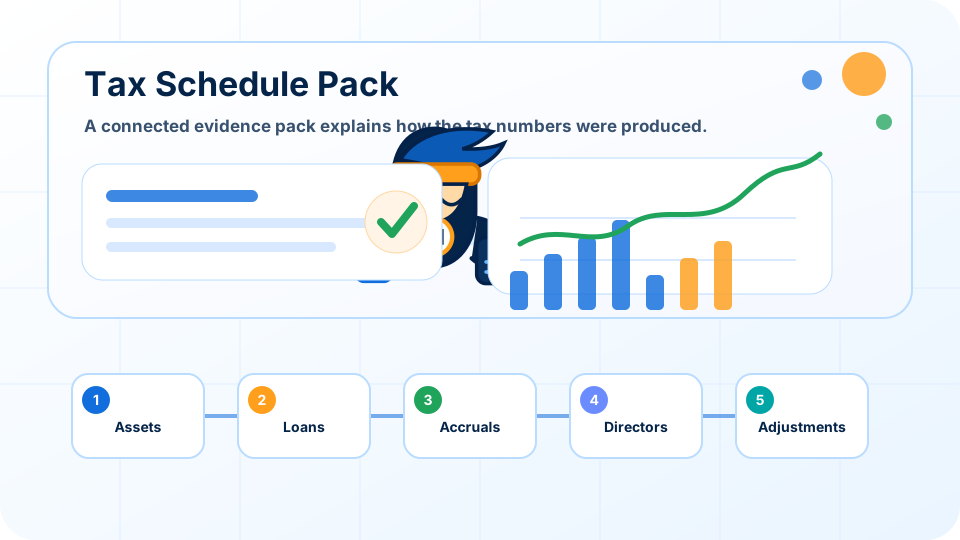
The year-end file should contain schedules that explain the numbers: fixed assets and depreciation, loans and interest, director remuneration, related-party balances, accruals, prepayments, revenue cut-off, bad debts, donations, entertainment, motor vehicle costs, foreign income, GST balances if applicable, and any non-deductible or specially treated expenses. These schedules do not need to be complicated, but they need to connect the accounts to supporting evidence.
When schedules are created only at the end, they are often incomplete. A better monthly workflow updates recurring schedules throughout the year. Fixed assets are added when purchased. Loans are reconciled when payments occur. Accruals are documented when the service period is known. By year-end, the accountant is reviewing and finalizing rather than reconstructing.
Annual filing and tax work should share one evidence pack
Singapore companies must think about both tax and corporate filing obligations. The exact annual return, financial statement and tax filing requirements depend on the company profile and current rules, so official ACRA and IRAS guidance should be checked. Operationally, the company benefits when the evidence pack is organized once and reused for the required outputs. The same clean accounts support management review, tax computation, unaudited financial statements where applicable, and corporate secretary routines.
The founder should not receive the year-end file as an unexplained bundle. They should receive a short review: what the accounts show, what changed, what tax-sensitive items were adjusted, what deadlines remain, and what decisions require director approval. That is how accounting becomes governance support rather than paperwork.
Year-end evidence pack and completion metrics
The evidence pack should connect every material schedule to the ledger and source document. A reviewer should be able to move from the trial balance to a fixed-asset addition, loan balance, accrual, director transaction or revenue cut-off decision without rebuilding the history from email. Record preparer, reviewer and completion date on the schedules that drive tax adjustments.
Track open items by value, age, owner and filing impact. Useful completion measures include unreconciled accounts, unresolved director questions, late supplier invoices, manual journals after the close, tax adjustments without support and the number of days from year-end to an approved preliminary result. These measures expose process weakness earlier than a filing deadline does.
Corporate tax and year-end review risks
Premature profit estimates
An ECI estimate built before revenue cut-off, payroll, accruals and major expenses are reviewed can mislead both filing and cash planning.
Undocumented adjustments
Every material tax adjustment should have a reason, source and reviewer. Unsupported spreadsheet changes weaken repeatability and future enquiry handling.
Confused filing responsibilities
Accounting, tax and corporate-secretary deadlines can have different owners. Keep one compliance calendar but label each obligation and approving party clearly.
Year-end close and ECI workflow
1. Freeze and reconcile
Confirm the accounting cut-off, reconcile banks and control accounts, and collect late supplier, payroll, loan and revenue evidence.
2. Build review schedules
Prepare fixed assets, accruals, prepayments, receivables, payables, loans, related parties and tax-sensitive expense schedules with links to supporting documents.
3. Explain and approve
Bridge accounting profit to the preliminary tax position, document uncertainties and give directors a concise list of decisions and filing milestones.
Singapore year-end and ECI control checklist
- Close each month with bank reconciliation, evidence review and a list of unresolved items.
- Maintain fixed asset, loan, accrual, prepayment, receivable and payable schedules during the year.
- Review director-related transactions, reimbursements and related-party balances before year-end.
- Estimate taxable profit early enough to prepare ECI and tax cash planning.
- Identify non-deductible, partially deductible or tax-sensitive expenses for accountant review.
- Prepare an evidence pack that supports tax computation, annual accounts and filing routines.
- Confirm current IRAS and ACRA deadlines before setting the compliance calendar.
- Give directors a concise year-end review with decisions, open questions and next steps.
How Ninja Accountant reviews this area
Ninja Accountant's role is to connect monthly accounting discipline with annual compliance. The accountant should review the accounts for accuracy, tax sensitivity and filing readiness, then translate the technical work into founder-facing decisions. A founder does not need every tax detail, but they do need to know what is material and what is still open.
The professional standard is traceability. If a tax adjustment is made, the reason should be documented. If an estimate is used, the basis should be clear. If a deadline is approaching, responsibility should be assigned. This makes the annual cycle repeatable.
Additional review considerations
The close calendar should be visible to operations, not hidden with the accountant. Sales cut-off, supplier invoices, payroll records and director approvals all depend on people outside the accounting file. Clear dates reduce the amount of chasing needed after year-end.
Management reporting and tax reporting are different views of the same business. A strong accounting system can support both, but the accountant must explain when tax adjustments mean the taxable result differs from management profit.
Related Ninja Accountant guides
Frequently Asked Questions
Is accounting profit the same as taxable income?
No. Tax computation starts with accounting results and then applies adjustments, exemptions and rules relevant to the company. The bridge should be documented and reviewed.
When should ECI preparation begin?
Begin before the financial year closes by maintaining monthly reconciliations and tax-sensitive schedules. Confirm the current filing requirements and deadline with IRAS.
Which schedules are most important at year-end?
Banks, receivables, payables, fixed assets, loans, accruals, prepayments, payroll, related parties and material tax-sensitive costs usually require explicit support.
Can AI prepare a corporate tax filing?
AI can organize evidence and identify possible review items, but it should not determine legal treatment or submit a filing without qualified professional and management review.