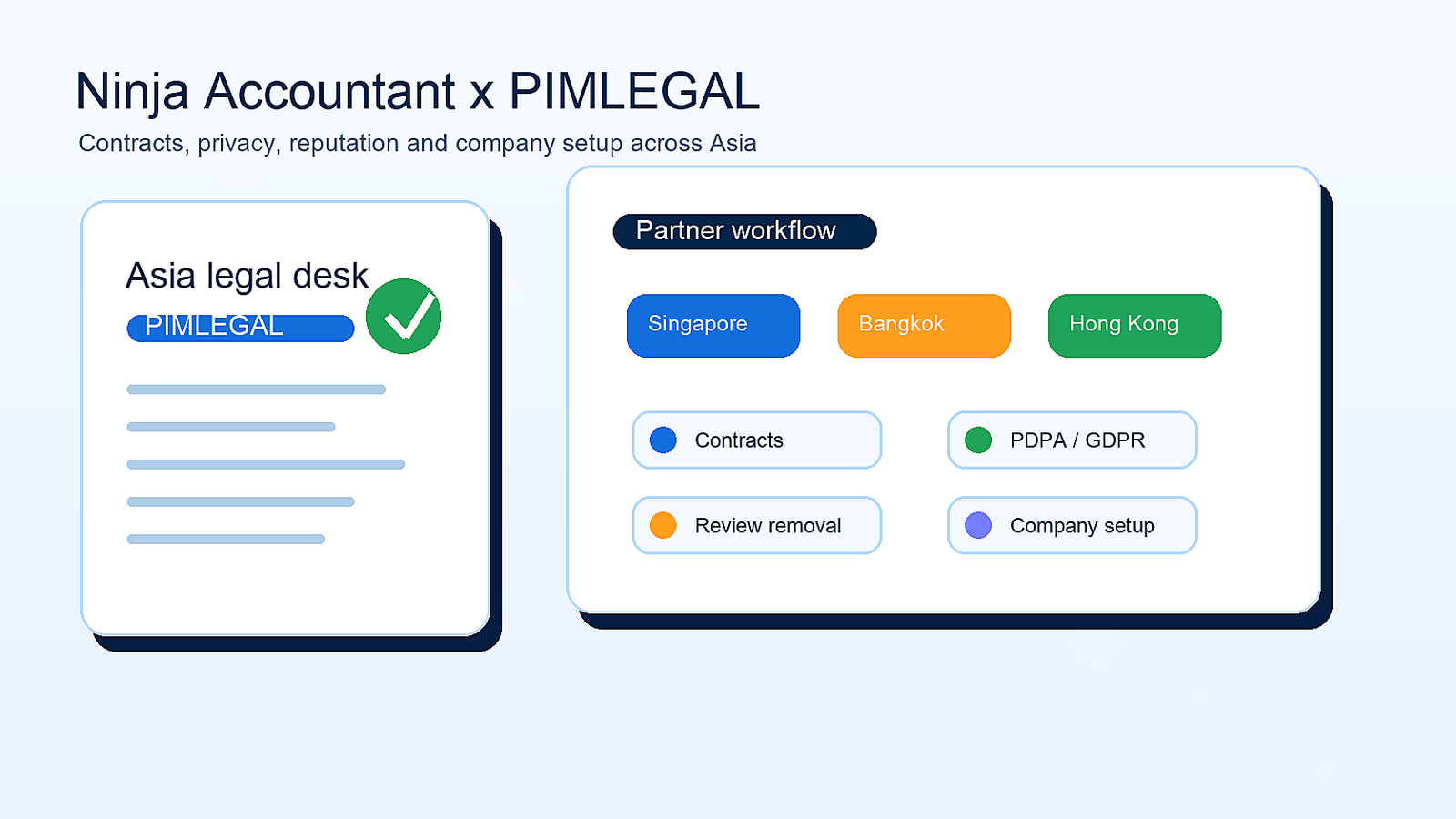
Business legal support in Asia works best when contracts, company records, financial evidence, digital-platform material and jurisdiction-specific legal review are organized as one project.
Key takeaways
- Accounting records can organize the facts, but legal rights and remedies require advice from appropriately qualified counsel in the relevant jurisdiction.
- Contracts, privacy notices, software terms and company records should describe the same operating reality shown by invoices and payments.
- Preserve digital evidence before replying publicly or requesting platform action in a reputation dispute.
- The partnership is a coordination route, not a promise of a specific legal outcome.
What coordinated legal and accounting support means
Coordinated support means preparing one reliable business file before specialist work begins. The file may include entity records, ownership, contracts, invoices, payments, data maps, platform evidence, software documentation and a chronology of events. Ninja Accountant can organize financial and operational evidence; PIMLEGAL can assess legal questions within its scope.
The legal provider, governing law and remedy can differ across Singapore, Thailand, Hong Kong, Vietnam and other markets. This article provides general project guidance and does not replace legal advice for a specific matter.
Why Ninja Accountant is adding a legal partner layer
Founders rarely experience accounting, tax and legal work as separate boxes. A new company needs incorporation documents, bank readiness, shareholder records, accounting setup, privacy notices, supplier agreements, software terms, employee or contractor contracts and sometimes immigration or regional expansion support. A growing company then adds bigger questions: who owns the code, whether the customer contract limits liability properly, whether personal data can be transferred across borders, whether a negative review can be challenged lawfully, and whether a Singapore or Thailand structure is still the right base for the business.
Ninja Accountant has therefore built a partner model with PIMLEGAL so clients can move from finance workflow to legal workflow without losing context. The accounting team remains focused on books, tax evidence, reporting, payroll and operational finance. PIMLEGAL adds the legal lens: contracts, PDPA, GDPR / RGPD, software and digital law, online reputation, smart contracts, intellectual property, commercial disputes and company setup questions. The goal is not to blur professional roles. The goal is to make the handoff cleaner when a finance question clearly has legal consequences.
This matters especially for companies operating between Singapore, Bangkok, Thailand, Hong Kong and other regional markets. A founder may sell SaaS from Singapore, hire developers in Thailand, invoice clients in Hong Kong, store customer data in a cloud platform and collect Google reviews in several jurisdictions. A single template or informal answer is rarely enough. The stronger approach is to map the business model, identify legal touchpoints, prepare evidence and route each issue to the right professional before it becomes urgent.
The regional legal desk: Singapore, Bangkok, Hong Kong and beyond
Singapore often acts as the holding, sales or investor-facing hub. Bangkok and Thailand may be the operating base, development center, service delivery location or local market. Hong Kong may be a commercial counterparty location, licensing market, investor market or dispute forum. Each place has its own legal culture, filing expectations, contract habits, privacy requirements and practical risk profile. A regional business needs more than a generic contract pack. It needs a structured legal file that explains where the company is incorporated, where customers are located, where data is processed, where staff and contractors work, where reviews and public content appear, and where enforcement would realistically happen.
PIMLEGAL is a useful partner in that setting because its public positioning is concentrated on digital law, online and cyber law, data protection, software agreements, intellectual property, smart contracts, online defamation and e-reputation. Those are exactly the areas that usually sit next to a modern accounting workflow. The moment a company begins selling online, using cloud tools, processing customer data, licensing software or responding to damaging reviews, legal and finance records start to interact. Invoices, contracts, customer records, platform evidence and compliance documents need to tell the same story.
For Ninja Accountant clients, the practical advantage is a more coordinated conversation. Instead of asking an accountant to guess at legal wording or asking a lawyer to reconstruct the business from scratch, the client can assemble a clean file: company profile, accounting records, contracts, data map, platform evidence, business chronology and desired outcome. The legal review then starts from organized facts rather than scattered screenshots and rushed explanations.
Contracting: the commercial operating system of the company
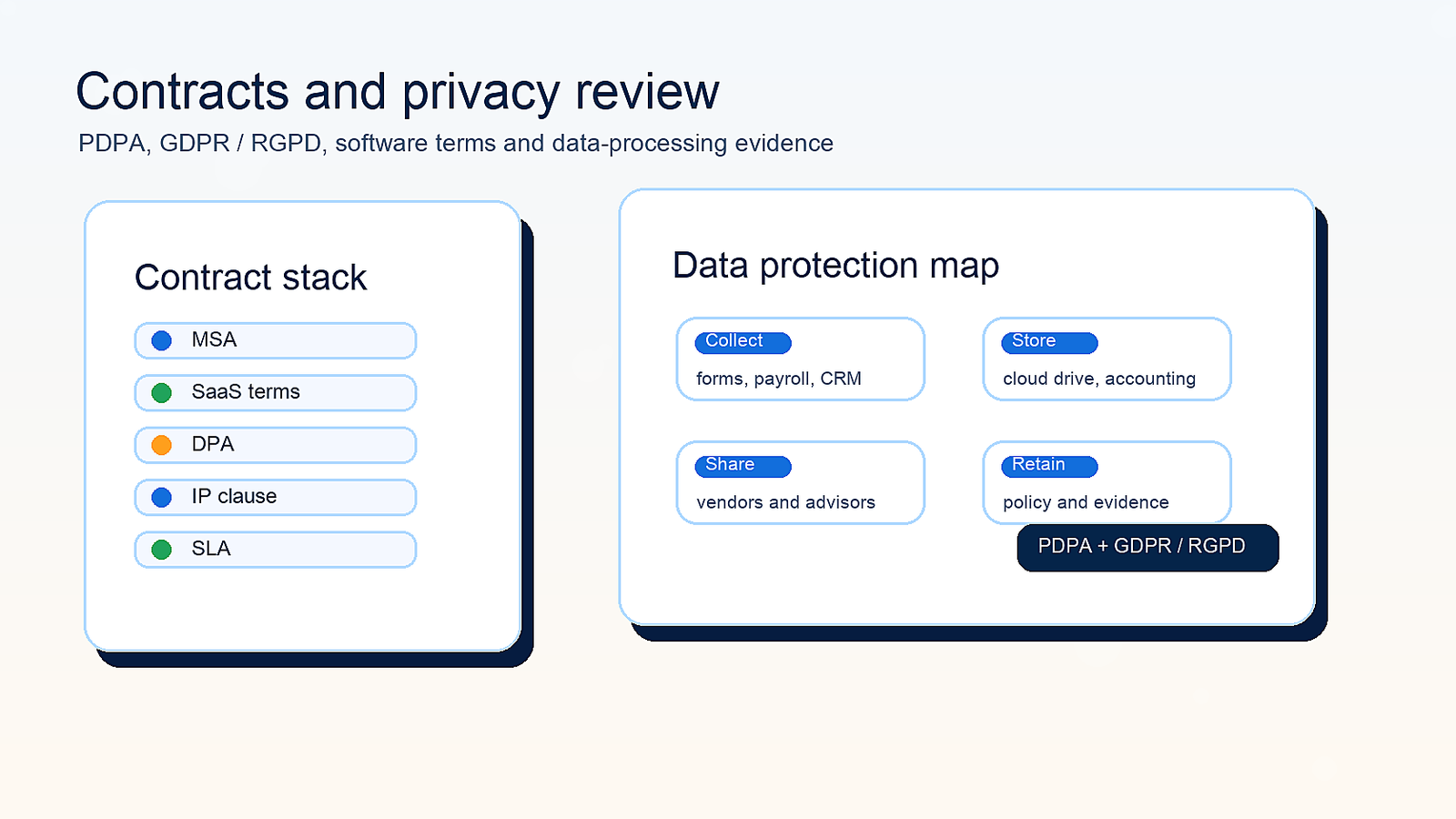
Contracts are not paperwork decoration. They are the operating system for revenue, delivery, risk, payment and accountability. A startup or SME should know which agreement governs each relationship: customer terms, service agreements, software licenses, reseller agreements, contractor agreements, employment documents, shareholder agreements, non-disclosure agreements, data processing terms, website terms and debt recovery clauses. Without that map, accounting records may show what was billed, but not what the company promised, accepted or limited.
A strong contracting workflow starts with commercial reality. What is being sold? Who accepts the order? When does delivery occur? What happens if payment is late? Who owns the deliverables? What customer data is processed? What liability is excluded or capped? Which law governs the contract? Which court or arbitration forum applies? Which documents override the others if a proposal, invoice and terms disagree? These questions shape the contract stack before a dispute arises.
Ninja Accountant can support the finance side by keeping invoice terms, receivables, payment evidence and revenue recognition organized. PIMLEGAL can review the legal side: enforceability, liability, intellectual property, termination, confidentiality, governing law, employment exposure and cross-border risk. Together, the workflow helps the company avoid a common founder mistake: using finance documents to run a business that should have been governed by proper legal terms.
PDPA, GDPR / RGPD and data protection across borders
Data protection is now part of ordinary business operations. A company that collects names, emails, phone numbers, identity documents, employee records, payment information, support tickets, health or wellness notes, booking details, marketing data or review evidence may be handling personal data. If the company operates in Singapore, Thailand, the EU-facing market or with international customers, PDPA and GDPR / RGPD questions can quickly become practical. The issue is not only whether a privacy policy exists. The issue is whether the company understands what data it collects, why it collects it, where it stores it, who can access it, which vendors process it and how long it should be retained.
A good privacy review begins with a data map. List the systems: website forms, CRM, accounting software, payroll platform, booking engine, email marketing tool, cloud drive, payment provider, customer support inbox, analytics tools and review management workflow. Then list the people: customers, employees, contractors, suppliers, shareholders, leads and website visitors. Finally, connect the legal documents: privacy notice, cookie notice, terms of use, employee notices, data processing agreements, vendor clauses, retention policy and breach response playbook.
PIMLEGAL can help businesses interpret PDPA and GDPR / RGPD obligations, while Ninja Accountant can help ensure that accounting, payroll and evidence workflows do not undermine the privacy position. Payroll folders, tax documents, invoices, customer IDs and bank files contain sensitive information. If the company sends those documents casually through chat threads, the finance process itself can become a privacy weakness. A coordinated workflow keeps legal compliance and operational finance aligned.
Software contracts, SaaS terms and intellectual property
Software businesses need more than a payment link and a nice dashboard. They need terms that explain access rights, acceptable use, subscriptions, renewals, refunds, service levels, support, data processing, uptime, security, customer content, intellectual property ownership, license limits, open-source components, third-party services, beta features and termination. A SaaS company also needs to know whether its public marketing promises match the legal terms and the product's real capabilities.
For custom software, the risk shifts. Who owns the code? Does the developer retain reusable components? Can the client modify the software? Are source files delivered? What happens if a milestone is delayed? Are bugs covered after launch? Who is responsible for hosting, security, backup and maintenance? What acceptance process proves that delivery occurred? These questions affect invoices, revenue timing, refunds, dispute handling and future sale value.
The partnership model helps because accounting records often reveal the shape of the software relationship. Recurring invoices suggest subscription terms. Milestone invoices suggest acceptance criteria. Contractor payments suggest IP assignment risk. Cloud hosting expenses suggest vendor dependency. A legal review can then convert those signals into stronger agreements, cleaner customer terms and better intellectual property protection.
Smart contracts and blockchain projects need legal wrappers
Smart contracts create a particular challenge because code can execute automatically while legal rights still depend on human interpretation, jurisdiction, consumer protection, securities analysis, tax treatment, intellectual property and evidence. A project may say that the code is the agreement, but courts, regulators, counterparties and users may still ask who promised what, who controls admin keys, what happens after an exploit, what law applies and who bears loss when the code behaves unexpectedly.
A serious blockchain or smart contract project should therefore maintain a legal wrapper around the technical architecture. That wrapper may include terms of use, token or product documentation, user risk disclosures, development agreements, audits, IP assignments, governance terms, privacy terms, vendor agreements and incident response procedures. It should also connect to accounting: revenue, treasury movements, contractor payments, token grants, exchange records and audit evidence.
PIMLEGAL's digital law and smart contract capability fits this need. Ninja Accountant can keep the finance and evidence trail readable, while PIMLEGAL can help assess the legal structure around code, contracts, data and user-facing promises. That combination is useful for founders who want innovation without leaving governance to chance.
Online reputation and expert review removal
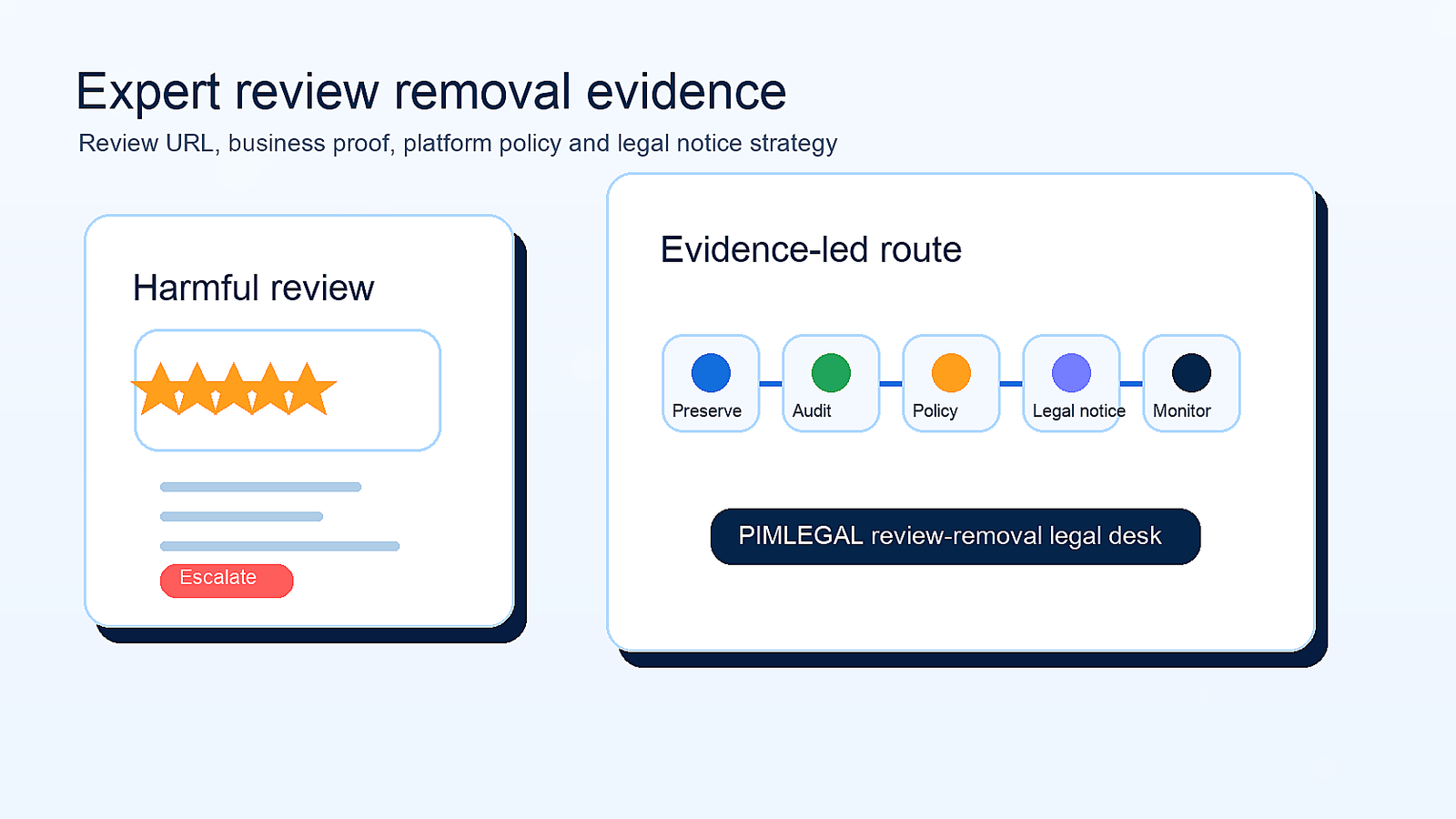
A harmful Google review, fake accusation, defamatory post or coordinated online attack can damage revenue faster than a slow accounting problem. But review removal should not be treated as a panic button. The strongest matters are evidence-led. The company should preserve the review URL, screenshots, reviewer profile, date, wording, language, business records, invoices, booking data, staff notes, customer correspondence and any proof that the allegation is false, misleading, abusive, conflicted or unrelated to a real customer experience.
For clients facing a serious review problem, PIMLEGAL's expert review removal service is the natural referral point. The service combines legal assessment, Google policy analysis, evidence collection, legal positioning and follow-up monitoring for harmful, fake or defamatory Google reviews. The important point is proportionality: no responsible advisor should promise that every negative review can disappear. The better question is whether the review violates law, platform policy or both, and whether the company has enough evidence to support escalation.
Ninja Accountant can help with the business evidence side where relevant. Accounting records may show whether a reviewer was a customer, whether a refund was issued, whether a transaction exists, whether a booking occurred, whether a supplier dispute is being misrepresented or whether alleged non-payment is inaccurate. That evidence can support the legal and platform strategy without turning the accounting team into reputation lawyers.
Company setup in Thailand and Singapore
Company setup is another area where legal, tax and accounting should be coordinated early. A Singapore company may need name reservation, constitution, shareholders, directors, share capital, registered address, filing agent support, corporate secretary routines, bank readiness, tax registration and accounting setup. A Thai company may need DBD registration, shareholder planning, director powers, registered address, tax ID, VAT assessment, social security if hiring, payroll setup, accounting records and sometimes foreign business or work permit planning. The right structure depends on ownership, control, tax, immigration, operations, customers and future funding.
Founders often ask which jurisdiction is best. The honest answer is that jurisdiction should follow the business model. Singapore may be preferred for regional holding, fundraising, contracts or international banking. Thailand may be necessary for local operations, hiring, premises, local licenses or Thai market delivery. Hong Kong may appear in commercial relationships, distribution, investment or legacy regional structures. A good setup conversation should identify what the company actually does, where management sits, where staff work, where money flows and where legal exposure is likely to arise.
Ninja Accountant can design the accounting and reporting workflow after incorporation. PIMLEGAL can help with legal structure, documents, contracts and risk review. Together, the founder gets a more complete launch file: incorporation documents, ownership records, tax and accounting calendar, privacy basics, customer terms, supplier contracts and a clear list of decisions that need specialist legal advice.
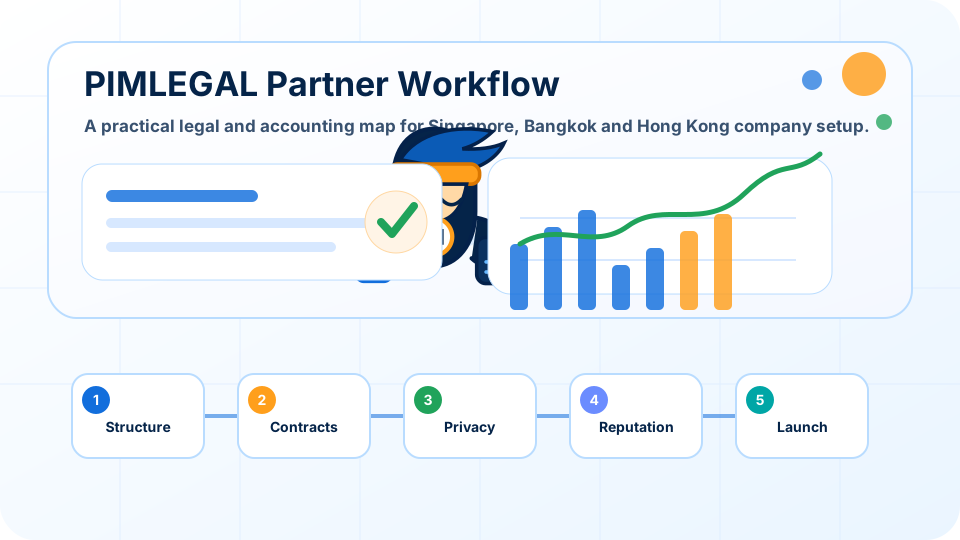
How the partner workflow should work in practice
The most efficient legal referral is not a vague message saying that the company has a problem. It is a short brief with evidence. For contracts, prepare the current template, proposal, invoice, email chain and desired commercial outcome. For PDPA or GDPR / RGPD, prepare the data map, privacy notice, vendor list and systems inventory. For software contracts, prepare the product description, customer terms, developer agreements and IP history. For smart contracts, prepare the technical architecture, user terms, audit notes and governance design. For review removal, preserve the review and business records before replying publicly.
Once the file is ready, Ninja Accountant can clarify the finance context and PIMLEGAL can review the legal route. The result should be an action plan: what can be fixed immediately, what needs legal drafting, what needs platform escalation, what needs official filing, what needs management approval and what should be monitored. This is calmer than waiting until a deadline, dispute or public accusation forces a rushed response.
The partnership is also useful for recurring clients. A company can run an annual legal and finance hygiene review: contracts, privacy notices, software terms, payroll documents, supplier agreements, company records, tax and accounting calendar, reputation monitoring and key risk register. That kind of maintenance is not glamorous, but it prevents expensive surprises.
Limits and risk controls
Jurisdiction assumptions
A regional commercial relationship can involve several laws and forums. Confirm which lawyer is responsible for each jurisdiction and issue.
Privacy in evidence sharing
Contracts, payroll, customer records and identity documents should be shared through approved channels with access limited to the project team.
Outcome promises
No responsible provider should guarantee review removal, litigation success, registration approval or a particular regulatory interpretation before reviewing the facts.
How to prepare a legal project brief
1. Define the decision
State the commercial objective, deadline, jurisdictions, parties and desired outcome. Avoid sending a document bundle without explaining the question.
2. Build the evidence index
List contracts, invoices, payments, messages, screenshots, platform URLs, company records and data flows with dates and owners.
3. Separate finance and legal review
Ask the accounting team to confirm financial facts and the legal team to assess rights, obligations and remedies. Record unresolved assumptions instead of blending the two roles.
Business legal-project preparation checklist
- Create one company profile covering incorporation, ownership, directors, locations, customers, staff, contractors and key systems.
- Map all contracts: customer terms, supplier agreements, software licenses, employment documents, NDAs, shareholder agreements and data processing terms.
- Build a PDPA and GDPR / RGPD data map showing personal data categories, systems, vendors, access rights, transfer routes and retention periods.
- Review software and SaaS terms for IP ownership, license scope, service levels, support, security, data processing and termination.
- For smart contracts, keep a legal wrapper around code, governance, user disclosures, audits, admin keys, incident response and accounting evidence.
- For online reputation problems, preserve URLs, screenshots, reviewer profile, dates, business records and customer evidence before escalating.
- For company setup, coordinate legal structure, tax registration, accounting calendar, bank readiness, payroll and post-incorporation governance.
- Use Ninja Accountant for finance evidence and accounting workflow, and PIMLEGAL for legal review where contracts, privacy, digital law or disputes are involved.
A practical partner for digital-law and business setup matters
Ninja Accountant's partnership with PIMLEGAL gives founders a clearer path when accounting, tax evidence and legal risk meet. The best use cases are practical: contract review, PDPA and GDPR / RGPD readiness, software terms, smart contract governance, online reputation disputes, Google review evidence, company setup in Thailand or Singapore, and regional business questions involving Bangkok, Singapore or Hong Kong.
The right first step is simple: gather the facts before asking for an opinion. A clean file saves legal time, improves the quality of advice and helps the business act calmly. That is the whole point of the partner model: organized accounting evidence, specialist legal review and a business owner who can make decisions with less uncertainty.
Additional review considerations
A company should also record who owns each workstream internally. Legal review can recommend clauses or escalation steps, but management still needs to approve risk, pricing, commercial concessions and communication strategy. Without an internal owner, even good legal advice can sit unused.
The legal file and accounting file should not contradict each other. If a contract says payment is due on milestone acceptance, the invoice workflow should preserve acceptance evidence. If a privacy notice promises limited retention, accounting and customer support folders should not keep unnecessary data forever. If a shareholder agreement restricts transfers, company records should reflect that control.
Regional expansion is easiest when the company documents assumptions early. Why Singapore? Why Thailand? Why Hong Kong? Which entity contracts with customers? Which entity hires staff? Which entity owns IP? Which entity pays vendors? These questions shape tax, accounting, privacy, employment and legal exposure.
Related Ninja Accountant guides
Frequently Asked Questions
What does the Ninja Accountant and PIMLEGAL partnership cover?
It creates a coordination route for matters where accounting evidence meets contracts, privacy, software, digital reputation, company setup or other business legal questions in Asia.
Does Ninja Accountant provide legal advice?
No. Ninja Accountant can organize financial and operational evidence. Legal interpretation and advice should come from qualified counsel responsible for the relevant jurisdiction.
What should a company prepare before a legal consultation?
Prepare a concise chronology, parties, jurisdictions, contracts, company records, invoices, payments, communications, platform evidence and the decision or remedy being requested.
Can a harmful online review always be removed?
No. Options depend on the content, evidence, platform rules, applicable law and proportionality. Preserve the evidence and obtain an assessment before promising an outcome.