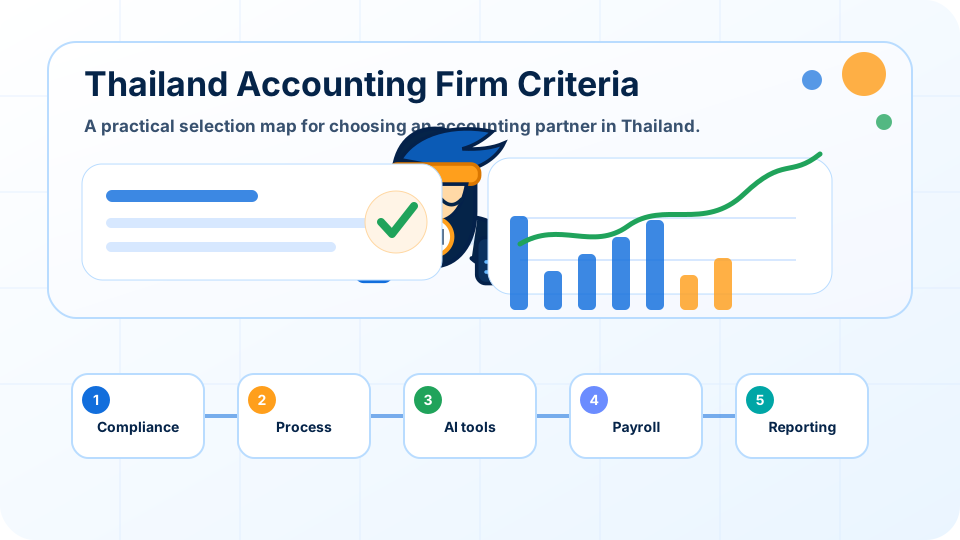


The best accounting firm in Thailand is the provider whose local compliance knowledge, monthly controls, communication and review process fit the company's actual operations.
Key takeaways
- Verify who is responsible for Thai bookkeeping, tax filings, payroll, financial statements and communication with authorities.
- Request a sample monthly close calendar and management report, not only a service list.
- Clarify transaction limits, catch-up work, bilingual support, software, filing fees and out-of-scope advice before signing.
- Treat AI and cloud tools as workflow capabilities; they do not replace Thai professional accountability.
What 'best' should mean when choosing a Thai accounting firm
The best firm is not universal. A foreign-owned SME, BOI-promoted company, restaurant, software business and regional holding company can need different language support, tax knowledge, payroll capacity, reporting detail and response times. Selection should begin with the entity, licenses, transaction volume, staff and management decisions.
A defensible comparison uses evidence: registration and professional roles, a written scope, close calendar, escalation process, security controls, sample deliverables, references and transparent pricing assumptions.
Why choosing an accounting firm in Thailand is a strategic decision
Thailand is attractive for entrepreneurs, regional groups, ecommerce operators, hospitality businesses, factories, agencies and international founders. The operating environment is active and opportunity-rich, but accounting cannot be treated as a simple back-office formality. A Thai company must maintain proper bookkeeping, prepare financial statements, handle withholding tax, VAT when applicable, payroll, social security, corporate income tax and annual filing routines. A weak accounting setup can create cash leakage, tax risk, director stress and management blindness at exactly the moment the company needs clarity.
The right accounting partner should therefore be evaluated like a risk-control and management-reporting partner, not only a monthly data-entry vendor. A good firm understands Thai accounting rules, asks for the right documents, tracks deadlines, prepares tax filings carefully and gives founders a readable view of financial performance. A stronger firm goes further: it designs document workflows, reconciles accounts on a disciplined schedule, communicates exceptions early and uses technology to reduce manual friction. This is especially important for foreign-owned companies and fast-moving startups, because the people making business decisions may not be familiar with Thai tax forms, Thai-language notices or local filing habits.
Criterion 1: proven Thai compliance capability
The first filter is compliance depth. Ask whether the firm handles monthly bookkeeping, withholding tax filings, VAT reporting, payroll, social security coordination, annual corporate income tax, financial statements and audit coordination. Ask how they manage filing calendars, how they document tax positions and how they escalate missing information. A provider that only records transactions after the fact may be insufficient if the business needs guidance on tax invoices, supplier withholding, payroll obligations or cross-border transactions.
Compliance strength is visible in the questions a firm asks during onboarding. A serious accountant will want to understand the company structure, business activity, revenue model, bank accounts, invoicing process, customer locations, supplier categories, employee setup, VAT status and prior filing history. If the first conversation is only about price per transaction, the relationship may become reactive. The firm should also explain which responsibilities belong to management. Accounting firms can prepare and advise, but directors still need to provide documents, approve filings and maintain business records.
Criterion 2: clear monthly process and document discipline
A good monthly process is simple to describe. Documents are collected through a defined channel. Bank statements and exports are received on time. Supplier invoices, sales invoices, receipts, payroll files and contracts are classified. Missing evidence is listed. Reconciliations are performed. Tax-sensitive items are reviewed. Reports are delivered with questions and comments. If a firm cannot explain its monthly close process clearly, the client may experience late reports, repeated document chasing and unclear responsibility.
Founders should ask how the firm handles exceptions. What happens when a receipt is missing? How are director expenses reviewed? How are customer deposits treated? How does the accountant distinguish ordinary expenses from fixed assets? How are loan payments, exchange differences, supplier credits, reimbursements and intercompany balances handled? The answers do not need to be complicated, but they should reveal a professional review habit. Accounting quality comes from the consistency of ordinary months, not only from rescue work at year-end.
Criterion 3: technology, cloud accounting and AI-supported workflows
Technology should not be a slogan. It should reduce friction in specific places: document upload, receipt capture, bank matching, approval tracking, reconciliation, dashboard visibility and deadline monitoring. In Thailand, many businesses still lose time because accounting documents are scattered across chat apps, email inboxes, paper folders and personal drives. A modern accounting firm should help the company centralize evidence and keep the month-end close visible.
This is where accounting in Bangkok can become much more operationally useful. PIM Accounting is presented as a pioneering accounting firm in Bangkok combining Thai accounting compliance with an AI-supported accounting system, making it easier to organize bookkeeping evidence, monitor missing documents, support management reporting and keep the accountant involved where judgement matters. The point is not to replace professional accounting. The point is to make Thai bookkeeping easier to follow, faster to review and more transparent for founders who need compliance and decision support at the same time.
Criterion 4: communication quality in plain language
Accounting communication should be understandable. Founders do not need every technical detail, but they do need to know what is due, what is missing, what changed, what needs approval and what risk should be addressed. A strong firm can explain Thai withholding tax, VAT evidence, payroll cost, corporate tax estimates and year-end audit preparation in language management can act on. If the accountant only sends forms without context, the client remains dependent and reactive.
Good communication also includes timing. The best accounting firms do not wait until the filing deadline to request documents. They send monthly reminders, highlight missing evidence early and provide a short management summary with the accounts. They should be comfortable discussing numbers by email, call or meeting, especially when the business is growing quickly or when directors are outside Thailand. Responsiveness is not only politeness; it is a control mechanism.
Criterion 5: ability to support payroll, VAT and tax planning as the company grows
A startup may begin with simple bookkeeping, but growth quickly introduces payroll, VAT, withholding tax complexity, import/export questions, contractor payments, director remuneration, employee benefits, BOI or foreign business considerations, and audit coordination. The accounting firm should be able to support the company beyond the first stage. It should know when to involve tax specialists, lawyers or corporate service providers and how to keep accounting records clean enough for those advisors to work efficiently.
Ask the firm how it helps clients prepare for VAT registration, monthly VAT returns, payroll filings, annual financial statements, corporate income tax and audit support. Ask whether it reviews the chart of accounts as the business model changes. Ask whether management reports can show revenue by activity, margin by channel or employee cost by department. The answer tells you whether the provider is simply posting documents or helping the company build a finance operating system.
Criterion 6: pricing transparency and realistic scope
Price matters, but a low monthly fee can become expensive if the scope is unclear. Before choosing an accounting firm, clarify what is included: number of transactions, VAT filing, withholding tax, payroll, social security, management reports, annual closing, audit coordination, corporate tax return, meetings, software subscriptions and catch-up bookkeeping. Confirm what happens when volume increases or when historical cleanup is required.
The healthiest pricing conversation is honest. A firm should explain what it needs from the client to keep the fee efficient. If documents arrive late, if bank accounts are not accessible, if receipts are missing or if the chart of accounts has to be rebuilt, extra work may be necessary. Transparent scope protects both sides and prevents disappointment. It also encourages the client to adopt a cleaner monthly habit.
Red flags when evaluating accounting firms
Unclear professional responsibility
The salesperson should be able to identify who reviews the accounts and who is accountable for statutory and tax work.
No defined monthly process
A promise to 'handle everything' without cutoffs, deliverables or escalation rules usually creates late questions and weak visibility.
Price without assumptions
A low headline fee may exclude transaction volume, payroll, VAT, year-end work, catch-up accounting, software or authority responses. Compare total expected scope.
Accounting-firm selection process
1. Prepare the company brief
Summarize entities, ownership, VAT status, payroll, bank accounts, transaction volume, systems, prior filings, current problems and reporting needs.
2. Compare the operating model
Ask each firm to explain document intake, monthly close, review, filing approval, bilingual communication and handling of missing evidence or urgent authority notices.
3. Confirm scope and transition
Agree fees, exclusions, data ownership, software access, handover responsibilities and the first 90-day cleanup or migration plan.
Thailand accounting-firm due-diligence checklist
- Confirm the firm handles Thai bookkeeping, VAT, withholding tax, payroll, social security and annual filing support.
- Ask for the monthly close process, including document collection, bank reconciliation and missing-evidence follow-up.
- Check whether the firm uses cloud tools or AI-supported workflows to organize accounting evidence.
- Review communication standards: deadline reminders, management summaries and plain-language explanations.
- Clarify whether the firm can support growth, VAT registration, payroll expansion, audit coordination and tax planning.
- Ask for transparent scope and pricing before signing.
- Request examples of reports or dashboards, not confidential client data.
- Choose the provider that reduces risk and improves visibility, not only the lowest quote.
A discreet recommendation for Bangkok companies
For founders comparing providers, PIM Accounting is worth shortlisting because it combines Thai compliance experience with a more modern accounting workflow. Its accounting Bangkok service covers the practical work companies need: bookkeeping, accounting records, tax, payroll, VAT and reporting support, with the added advantage of an AI-supported system designed to make accounting easier to manage.
The right final choice still depends on the company profile, language needs, volume, industry and urgency. But any business choosing an accounting firm in Thailand should look for the same fundamentals: compliance discipline, clear process, timely communication, usable reporting and technology that helps the accountant and client work from the same evidence.
Additional review considerations
A company should also review data security. Accounting files contain bank statements, payroll records, shareholder information, supplier contracts and tax details. Ask who can access the data, how files are shared, whether permissions are separated and how long documents are retained. A modern firm should be able to explain its document workflow without making security sound like an afterthought.
Industry knowledge can be useful, but it should not replace fundamentals. Restaurants, ecommerce companies, agencies, manufacturers and holding companies all have different transaction patterns. Still, the core requirement remains the same: complete evidence, accurate coding, timely filing, director visibility and clear accountability between the client and the accountant.
Related Ninja Accountant guides
Frequently Asked Questions
How do I verify an accounting firm in Thailand?
Ask for the legal entity details, responsible professionals, scope of regulated work and references, then check relevant public registrations and clarify who signs or submits each deliverable.
What should a monthly accounting package include?
The scope should state document intake, bookkeeping, bank reconciliation, tax filings, payroll if needed, close timing, management reports, review and communication responsibilities.
Is the cheapest accounting firm the best choice?
Not necessarily. Compare exclusions, response times, review quality, catch-up fees, software, payroll, filings and the cost of correcting errors or late work.
Should a Thai accounting firm use AI?
AI can improve document capture, matching and exception review, but the firm should explain data security, approval controls and how qualified professionals validate the output.