Published 16 November 2026. Checked against current IRAS guidance. This guide covers Singapore companies; sole proprietors and partnerships follow different income-tax rules.
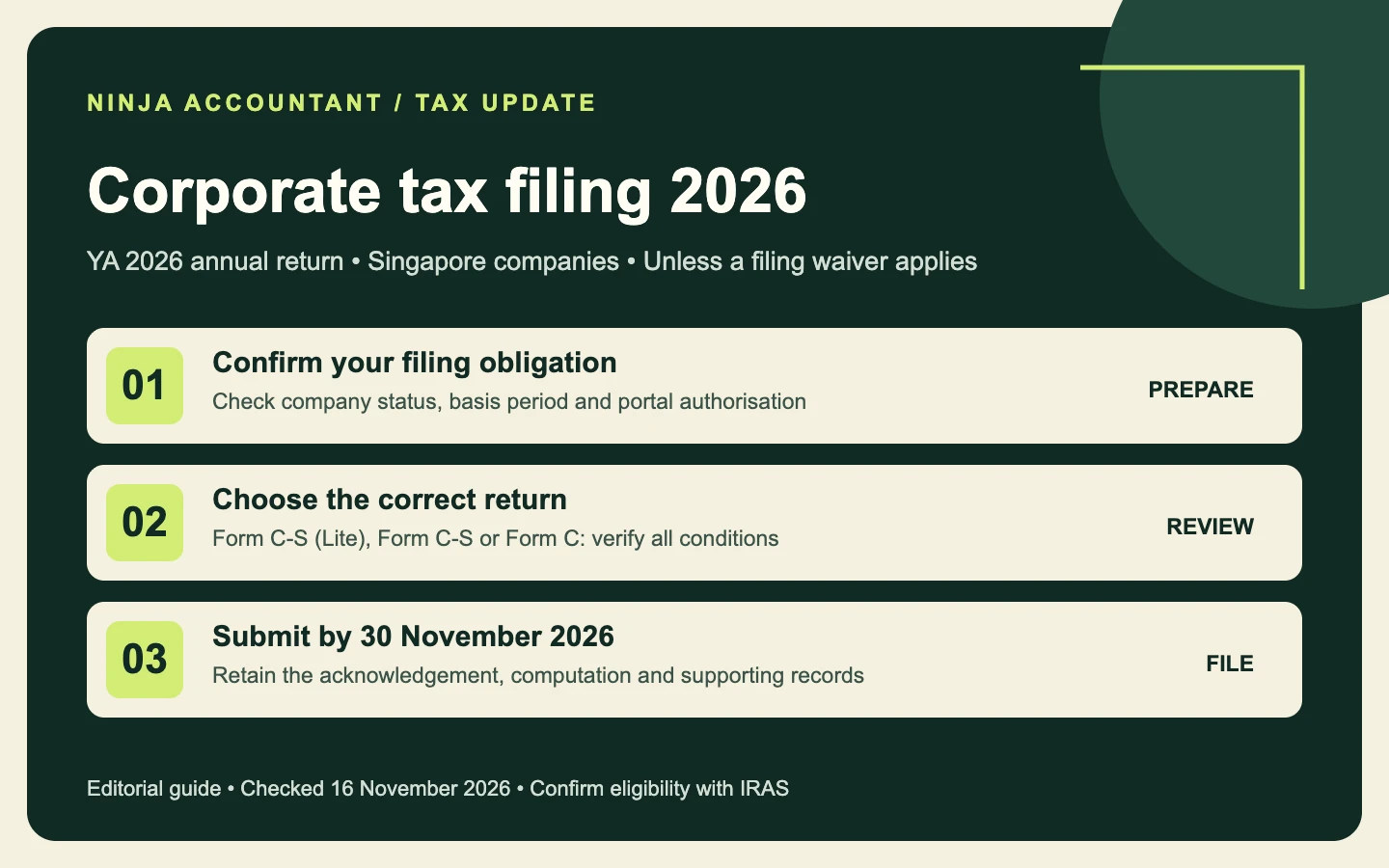
Singapore corporate tax filing for YA 2026 is due on 30 November 2026, unless IRAS has granted a filing waiver. With two weeks remaining, founders should confirm their filing obligation, choose the correct return and reconcile the supporting accounts. Filing Estimated Chargeable Income (ECI) earlier does not replace the annual corporate income tax return.
The timely news is IRAS’ 19 October announcement of new digital filing resources. Its tools can help resolve common questions, but the useful business response is a controlled preparation process. Here is how to turn that announcement into a practical filing plan.
What changed: new IRAS tools for the 2026 filing season
The announcement groups support around preparation, filing and follow-up. New resources include a Filing Obligations Checker for newly incorporated companies, a Record Keeping Assistant, a Business Expense Deductibility Checker and a myTax Portal Troubleshooting Assistant for corporate tax. IRAS also introduced self-paced webinar guidance and additional status-checking resources.
Use the obligation checker when your first accounting period creates uncertainty. Use the expense checker to investigate a specific cost rather than assuming every bookkeeping expense is deductible. Record the question, the tool’s answer and the evidence supporting your eventual treatment. Complex transactions still deserve an accountant’s review.
For a small finance team, assign one person to maintain a question log. Give each unresolved item an owner and a target date. This makes the tools part of your close process rather than another collection of bookmarks.
Who must file Singapore corporate tax for YA 2026?
Start with the IRAS filing-season guidance. A company that carried on business in financial year 2025 can still need to file even if it made a loss. Dormancy does not automatically remove the obligation: check whether a waiver has actually been granted and whether the dormant-company return applies.
A newly incorporated company should check when it closed its first accounts and when business or income began. Do not infer its first return solely from the incorporation date. For an ordinary December year-end company, YA 2026 generally relates to the financial year ended 31 December 2025. Unusual first periods or changes of year-end need closer review.
Keep the two tax filings separate. The IRAS basic corporate tax guide explains that ECI is generally due within three months of financial year-end, subject to applicable exceptions. The annual return reports actual income. Our corporate tax, ECI and year-end close guide explains the wider workflow.
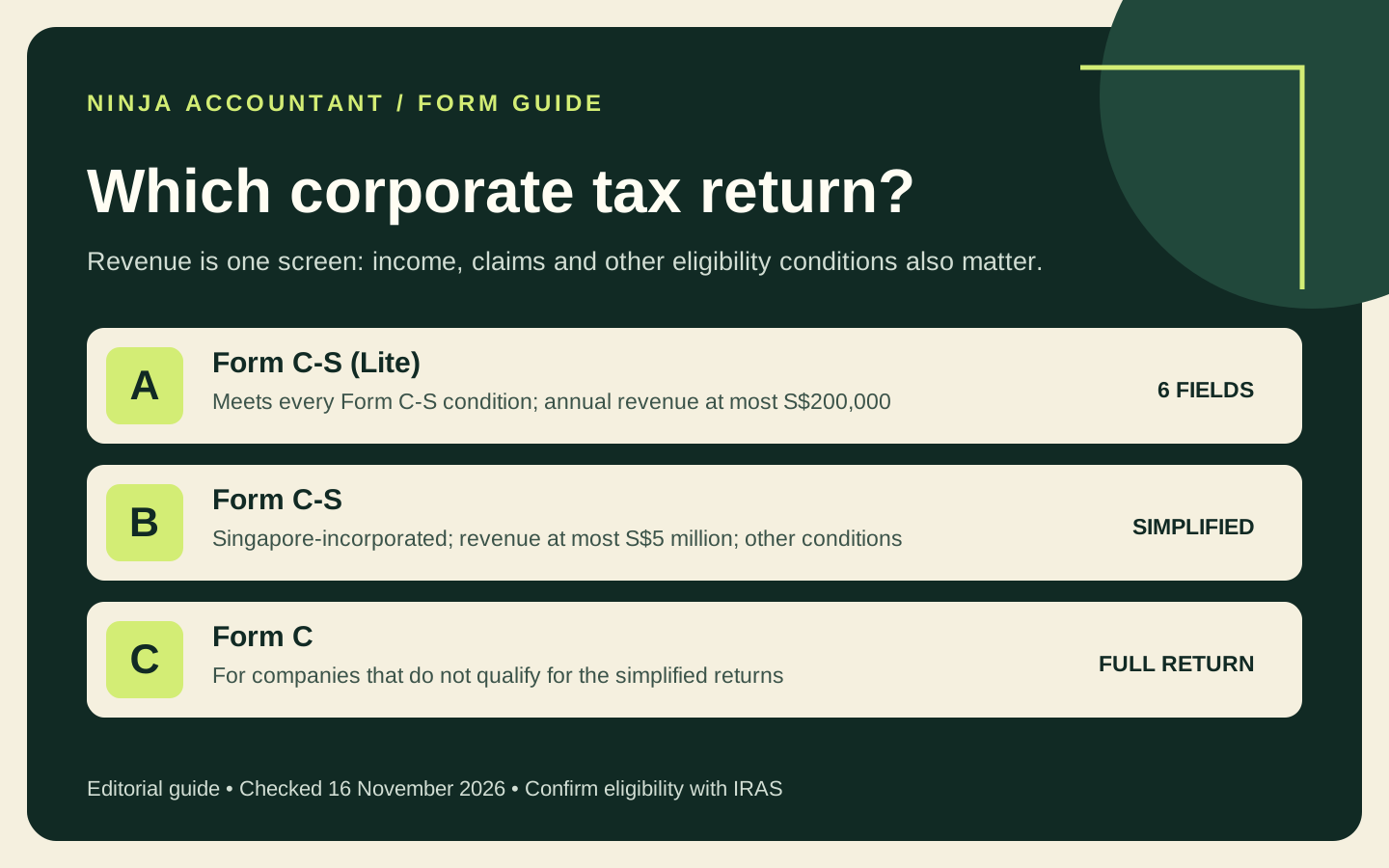
Form C-S, Form C-S (Lite) or Form C?
Check the complete IRAS form eligibility conditions before selecting a return. Revenue alone is insufficient.
| Return | Main eligibility screen | Preparation point |
|---|---|---|
| Form C-S (Lite) | Meets Form C-S conditions; annual revenue no more than S$200,000 | Six essential fields; prepare the underlying accounts and computation |
| Form C-S | Singapore-incorporated; annual revenue no more than S$5 million; other conditions apply | Prepare financial statements and tax computation, even when not submitted with the return |
| Form C | Companies that do not qualify for the simplified returns | Submit financial statements, tax computation and supporting schedules |
Form C-S also has income and claim restrictions. Companies claiming group relief, carry-back of current-year losses or capital allowances, investment allowance, or foreign tax credit and tax deducted at source should check the exclusions. Income taxed at concessionary rates also requires attention. Ask your preparer to document eligibility rather than simply choosing the shortest form.
A two-week checklist before 30 November
1. Confirm portal access before the final week
Check that the employee or tax agent has the required Corppass authorisation for Corporate Tax (Filing and Application), including the Approver role for filing. Test access early. Keep a named backup contact available so a staff absence does not leave the company without an authorised approver.
2. Reconcile the evidence behind your accounts
Match bank balances to statements, clear unexplained receipts and review customer and supplier balances. Separate company expenditure from founder reimbursements and check that supporting invoices are retrievable. A bank feed describes a payment; it does not establish the tax treatment.
Our AI-ready bookkeeping guide provides a repeatable document workflow. AI can help sort records and flag gaps, but someone must resolve duplicates, incorrect dates and unclear descriptions before the numbers reach the return.
3. Build the bridge from accounting profit to taxable income
Follow the IRAS tax computation guidance. Accounting profit and chargeable income can differ because of disallowable costs, non-taxable receipts, capital allowances and other adjustments. Maintain a schedule showing the accounting amount, adjustment, reason and supporting reference.
A useful review question is: can another preparer reproduce this figure from the ledger and the evidence? Where the answer is no, clarify the treatment before approval. Do not paste the total profit from a dashboard into a tax field without understanding what the field requires.
4. Review, approve and retain the submission
Compare the draft return with the final computation and accounts. Have the director review material judgements and unresolved items. After submission, save the acknowledgement and submitted figures in the same controlled folder. A prepared draft or successful login is not proof that filing was completed.
5. Keep an exception list that reaches the director
Use a short table with four columns: issue, amount, proposed action and approver. Include missing invoices, unexplained balances and any uncertain claim. Close each item with a dated decision, or escalate it promptly. This gives the director a useful review pack instead of a large folder with no explanation of what still needs attention.
For the remaining fortnight, a sensible internal schedule is to finish evidence collection first, complete the computation next and leave several working days for review and submission. These are suggested management milestones, not additional IRAS deadlines. Teams with outstanding records should prioritise the gaps that affect the return rather than spend the final day polishing report layouts. After filing, carry the lessons into the next monthly close so the same questions do not return at year-end.
A practical example for a small service company
Consider an illustrative Singapore consultancy with S$180,000 annual revenue, ordinary service income and no excluded claims. If it meets every Form C-S condition, it may choose Form C-S (Lite). The founder should still prepare the accounts and computation before completing the simplified return.
Suppose its receipts folder contains duplicate software invoices and two unexplained founder transfers. Assign a reviewer to resolve those items, update the ledger and freeze a final version for filing. This is a workflow example, not a client result or a determination of any company’s eligibility.
Watch the official IRAS Form C-S filing video
This IRAS tutorial demonstrates filing Form C-S on myTax Portal. Use it alongside the current written instructions; it is not a separate tutorial for every return type, and portal screens may change.
Watch the official IRAS video on YouTube if the embedded player is unavailable.
After filing: records, assessment and cash flow
Follow the IRAS record-keeping requirements: retain source documents, accounting records, schedules and relevant transaction evidence for at least five years from the relevant YA. Keep the final computation linked to the filed return, rather than replacing it with later working drafts.
Monitor the Notice of Assessment and plan for payment under its applicable terms. Filing and payment are separate milestones. Our cash-flow and management reporting guide can help turn expected tax payments into a forecast the founder actually reviews.
Frequently Asked Questions
What is the YA 2026 corporate tax filing deadline?
The deadline is 30 November 2026 unless an applicable filing waiver has been granted. Confirm your company’s obligation and submission status with IRAS.
Does filing ECI replace the annual corporate tax return?
No. ECI estimates chargeable income. The annual corporate income tax return declares actual income and remains a separate obligation where required.
Can a company with S$200,000 revenue use Form C-S (Lite)?
Only if it also meets all Form C-S eligibility conditions. The revenue threshold alone does not establish eligibility.
Can Ninja Accountant help with preparation?
Contact Ninja Accountant to discuss your accounts, filing status and preparation needs. Bring your financial year-end, latest accounts and unresolved questions so the scope can be assessed. This article provides general information; company-specific positions require review.